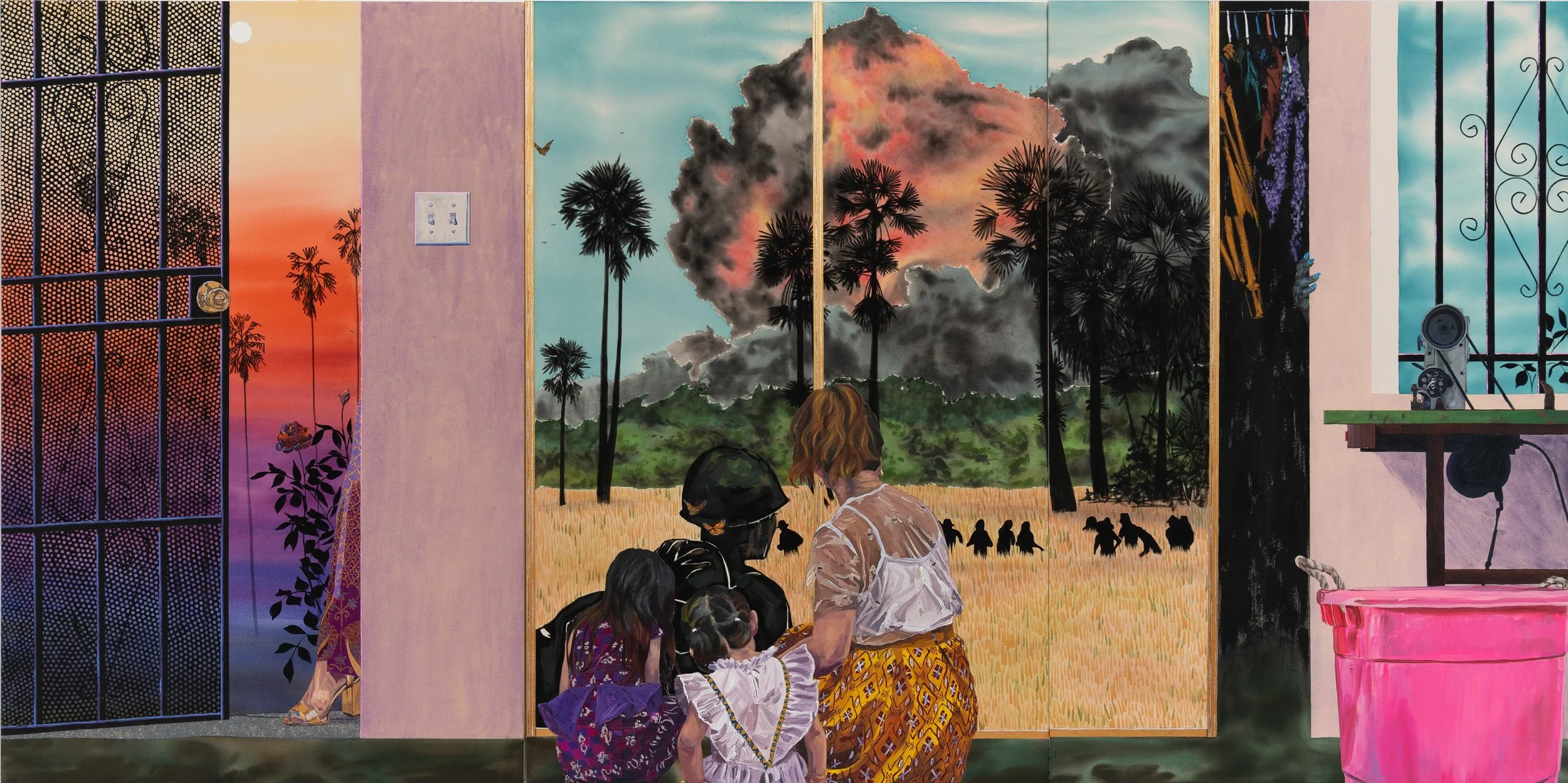
Refuge, 2023
Earlier this spring, I visited Tida in her bright and airy studio. The first time I saw her work in person was at a press preview of Made in LA in 2023 at the Hammer Museum. Her large painting flanked the entry to the big exhibit and it blew my mind; I became so connected to her story. The way she collaged important memories and images of her Cambodian American culture with strong color and composition really stayed with me. I thought about it for months after that day. I still think about it. Refuge, the huge 12-foot-wide three-panel triptych, conjures consequences of displacement, war, and community. She carefully places the Vietnam War in context with her own family, showing us the terror of the invasion of Cambodia on the surface of a closet door in the home, near a wrought iron low-income screen door and her mother’s sewing machine. There’s a tragic mood inside this transcendent moment that often only the refugees and their families remember - their fate at the hands of American industrial militarization. Consider an anti-war message from a painter in Long Beach and contemplate the impact violence continues to have on humans today and the journey of the immigrant. Her work is important, personal, and visually compelling.
We first met in person outside a bar in Hollywood at an art opening afterparty. Comfortable talking on the street, I sensed her for realness and couldn’t wait to talk more with her about painting. Visiting her studio, she served us tea and I appreciated a long a wall of windows, where she shares her space with all kinds of beautiful plants.
TRINA: Did you have artist role models? Or was there something that inspired you to become an artist?
TIDAWHITNEY: That journey took a while because it wasn't until college that I was like, oh, maybe I can go in this direction. But since I was young, like if I had to think back to grade school, I could tell by first grade people were pointing it out and I could tell already by kindergarten that I had a pretty good sense of what to do next. I could tell what to do next in this craft, and along the way, from middle school to high school, I was getting the same thing. I got a lot of response from the students all the time too. I did always know when the teachers or professors pulled me to the side and said, "Oh, you got something,” and it happened very often. I had an art teacher, who really was emphasizing, “Maybe you should go to this college, they have a great art program.” I knew of the school already because my sister was attending.
TRINA: Is your sister an artist?
TIDAWHITNEY: She’s not an artist. She switched majors a couple times before she ended up with graphic design. I was like, okay, maybe, I’ll see what the deal is and went to the same school. But I still wasn't sure because I'm painting, and like, making money? You know what I mean, I was like, don't sound like you could just make money like that. I was like, it doesn’t make sense to me, you know? For her, I get it. But I went undeclared and had to choose a department and I decided, okay, fuck it, drawing and painting.
Painting was already a familiar medium. I knew I excelled, and was advanced in high school, so okay, let me take it up a notch. I could see it being anything, in terms of a career, towards being a teacher.
TRINA: You had good teachers. They saw it in you.
TIDAWHITNEY: I'm like, oh, that's a good example. I could teach, but I'm not really thinking about what that career really means. It's only until I meet my faculty - and it's very interesting with them because at the time the department was split. There was a battle between figurative and abstraction and they were ready to retire (laugh) on top of that. I got the best energy that they had for their students because they were like, "We're gonna give you everything and we don't give a fuck if you care because we dip now.”
TRINA: Wow. They were going for broke.
TIDAWHITNEY: Like everything they had, and they would be like, "One of you guys are gonna make it or none of you guys don't make it.”
TRINA: Exactly.
TIDAWHITNEY: Peace.
TRINA: Peace.
TIDAWHITNEY: Yeah. (laugh)
TRINA: What school was that?
TIDAWHITNEY: Cal State Long Beach.
TRINA: And you were like the youngest daughter in a large family, right?
TIDAWHITNEY: Youngest daughter out of seven and I'm number six.
TRINA: Did you have expectations from your parents because of all these other kids? Or did you feel like they were a little more lax on you?
TIDAWHITNEY: There were definitely expectations because of the way we grew up. My parents are pretty messed up from the genocide and their whole generation is just messed up so in the Cambodian community, everything was never enough. You were always a position of survival. If you weren't in a place where you could live nicely, then that means you didn't succeed, you know? And we were always living off Section 8 housing. We had government assistance. We were on food stamps. My mom had seven kids and she didn't really work; it was my dad that was working and he wasn't working great paid jobs. He did Khmer dubbing for Chinese dramas that used to be on VHS tapes. Khmer is our language for Cambodian folks. That's how he made money, at least when I was born. I remember him doing those jobs, and that wasn't paying, it couldn't cover the bills anymore, so he had to be a casino dealer. The VHS thing phased out, turned to CD and then turned into streaming.
TRINA: I think a lot of people who are refugees or come from families who are displaced, the expectations are that you're going to be devoted to helping your family and that you're going to succeed at it because you must. How did they manage their expectations around you saying you were going to study art?
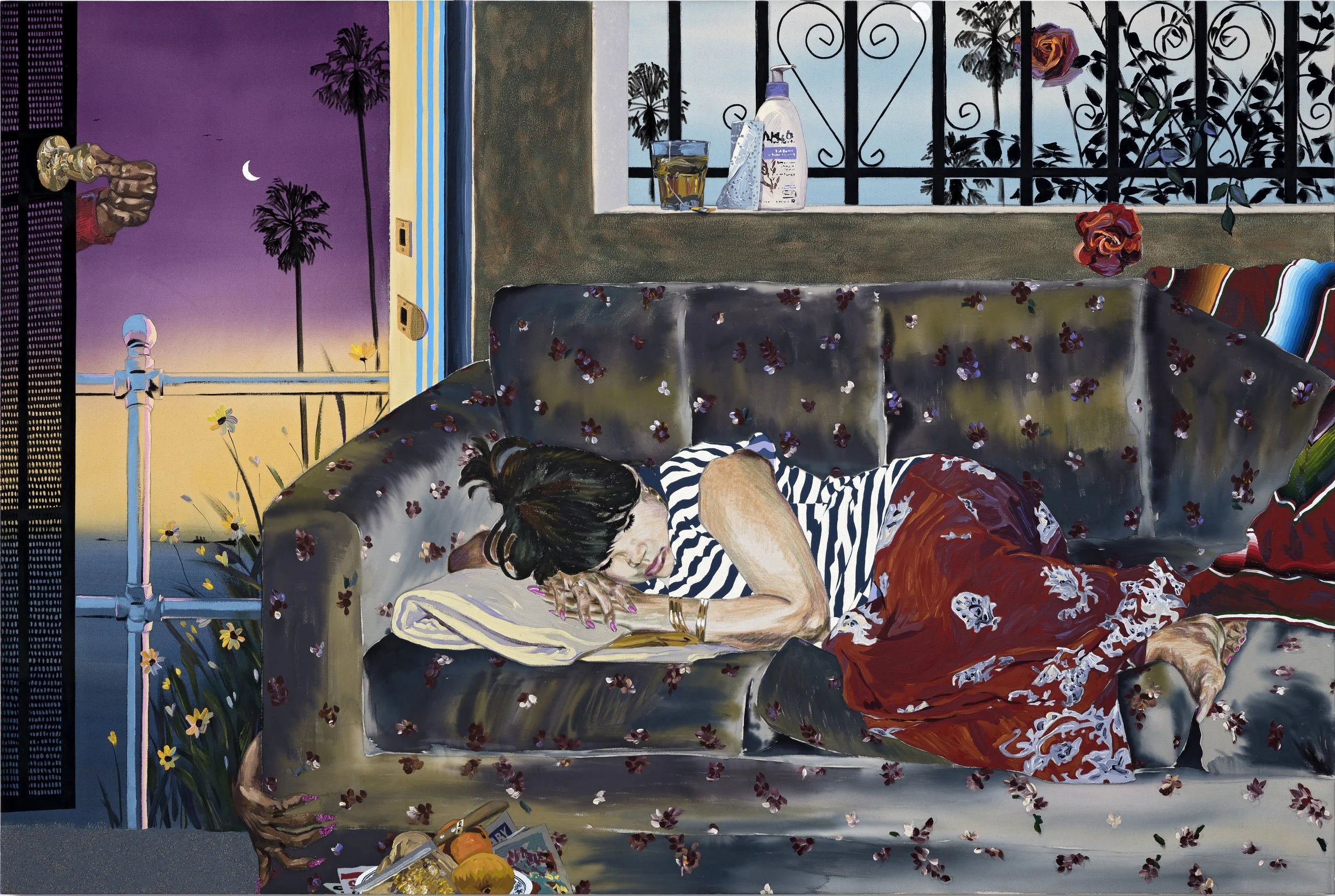
Napping, 2022
TIDAWHITNEY: They didn't (laugh)…I guess it was just like, no communication. On top of that, it's like there’s five older siblings, they're going through it first and they kind of just see me as a little sister. For me, nothing would ever meet their expectations because they could not understand where my achievements were getting me.
TRINA: Yeah.
TIDAWHITNEY: It was also because I'm number six out of seven, you're kind of like forgotten. I would call me and my little brother the second batch.
TRINA: Is there a substantial years difference between you?
TIDAWHITNEY: It's like four years and up. My oldest brother's like 10 years older than me and then from there it's like nine, seven, five, four.
TRINA: Yeah, it's different.
TIDAWHITNEY: I had examples in front of me. I was like, "Oh, you tried it this way, you tried it that way, you tried this way that day." I was like, "Oh, you all unhappy." I don't know. You notice that.
That's what convinced me to be like, I think I'm going to do what everybody else is telling me I'm really great at and see for myself where it's going to go. This college thing is supposed to set you for life in some way somehow. I almost wasn't gonna go and then because of a scholarship I was like, okay, I'm going. That in itself is a conversation a lot of my peers don't even have with their own parents. I know it's not crazy. I feel like my siblings didn’t have that conversation because we were so poor. I didn't decide to be an artist until like 2014. I was in the middle of college and had three years left.
TRINA: I understand you had an eye-opening art experience when you went to New York, almost more so than being in L.A. What was it that catapulted that change in perspective?
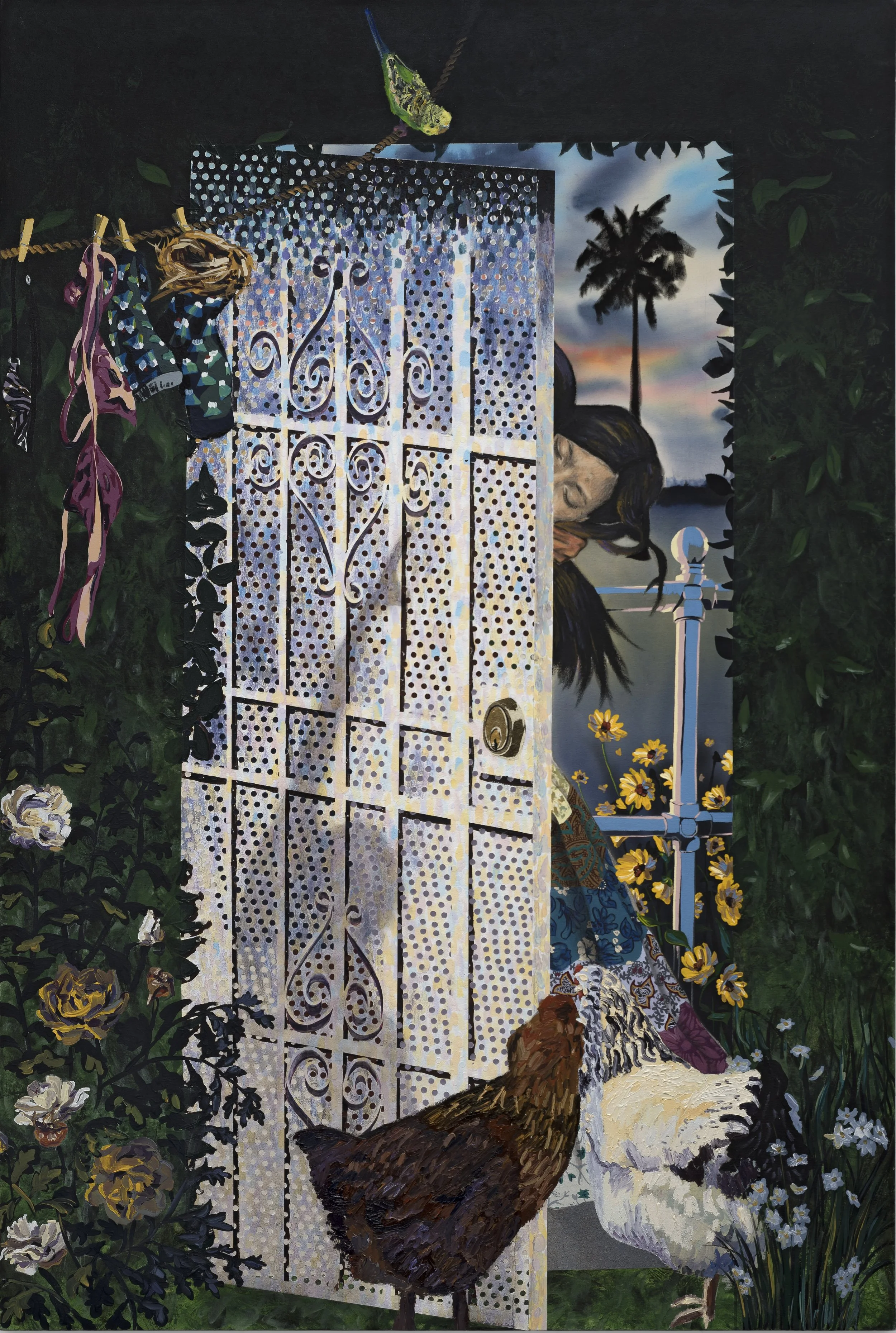
On the Other Side, 2019
TIDAWHITNEY: This is probably the other part of the story that people don't know about 2014. In 2014, when I decided to be an artist, it was for one, because of the New York trip. It happened and then two, well, it was actually number one, was I was getting out of a toxic relationship and it took a long time for me to recover. This is kind of what forced me to mold myself into an artist. I dropped everything and decided to turn all my attention into art, into this whole thing of what does this mean in the scope of everything.
The relationship was super abusive physically, emotionally, mentally, and when I got out, the New York thing was happening and I was like, this is a great time to break up again because, because you won't run, you won't let him back in. You're off in New York and no matter what you do, you can't get to him.
There was an email though and I opened the email, just another toxic paragraph, and something literally just switched and I went to bed. I was like, I'm done with this. I remember the next morning I was like, wow, I'm in New York. I don't have to go back to this shit right now.
That trip is like a blur. I can't remember every detail, but I do remember what I went through because it was the most jungle, wildest thing I’ve ever experienced. I'd never been to New York before, never even really been out of Long Beach at that point. I didn't know anything about L.A. I hadn't been exposed to any of the art scene. I was only in my bubble of Long Beach. New York burst that scene. And then that year I got scholarships. I had like two or three and when I came back from that trip, I was like, maybe this is gonna work out. They're throwing money at me (laugh), right?
That New York trip, I didn't pay for anything but the food I ate and we saw so much. It was like 12 studios and that alone was a huge eye opener because I saw studios in people's homes. I saw studios in other buildings far from their homes, different locations close to New York, and far away from New York. There was a really a good variety to see and it all depended on how you want to live with the rest of the world.
It was like, be careful what you wish for. Again, if they're doing it, you must be doing something right. Like you must be going in the right direction. And your parents, your family, can't tell you this, right? Your family doesn't know. What about your friends? Can your friends tell you? They don't fucking know. None of them have any idea. It can feel very lonely, right?
TRINA: Yes. I'm glad you said that. It does. It is a lonely place, and you just have to get comfortable. I'm curious, what were you painting in college? It sounded like you were doing abstraction first and then went more figurative. Am I right?
TIDAWHITNEY: You're correct in terms of the order and how I made a conscious decision all the way through because of the condition of the environment that was set up for me. The abstraction, the figurative, there was a rift, it was like, "Yeah, you guys pick this or pick that.”
I decided abstraction because I just was so like, the no shit, right? Whereas I felt like figurative was pretty digestible.
TRINA: People relate to it.
TIDAWHITNEY: Yeah, very quickly. So, with that being said, I was like, well, I guess I could take my time with that because I can register really quickly, but with this, I'm just so oblivious. I decided this is perhaps where I should begin and I guess I'm not your typical person where I follow orders. (laugh) Because they tell you, "Oh, you need to pick these classes, take these classes." And I didn't do that. I was like, no. I'm gonna pick the ones that I'm wondering about right now. And it was a good combination.
I really needed knowledge, needed information. I needed to understand and to figure out how to do what you're tasking me to do. With that said, abstraction became my foundation, my building block. It makes more sense in terms of, if I were to teach anybody how to paint, how to draw, how to be a creator in that format, this is where we would begin because it's a very simple notion but the complexity of it is how we can place it in different facets, forms and perspectives, right? Or even just mold and change it. It's like there's numerous ways and it's up to you and, and there's no such thing as you owning it because it's too accessible, right?
TRINA: Yeah.
TIDAWHITNEY: It's too accessible for everybody. But how you choose to put it all together is what makes you different. That's what I understood from, built from, those foundations and only until I left school did I make room to be more specific in terms of me as an individual.
TRINA: Who were those abstraction teachers at Cal State Long Beach? Who was the big like abstraction cheerleader?
TIDAWHITNEY: Oh my God, I call her my coach (laugh) in my head. She's awesome because she's the one that actually convinced me to just extend my program. She saw something in me and she's like, "Hey, Tida, you should apply for this BFA program." I didn't even think nothing of it. I was like, "Oh, this woman's telling me to apply. Okay." I ended up extending college two more years. I was like, "Did I just do that?" It turned out being the best thing for me because I think this is actually important in terms of time for students to experience what they're doing. Her name is Marie Thibeault.
She was my color theory and abstract professor. There's also Siobhan McClure, she's great because she saw that there was an opportunity in terms of the subject matter that I'm doing now, and she always questioned me during school about it.
But because, remember I came out of this abusive relationship, I really wanted to recalibrate and I would tell her, ‘Yeah, I'm not interested in it. I'm just putting that to the side.’ (laugh) But she had this wonderful way of noticing that it had a very strong feelings.
TRINA: I can only help but think that coming out of a relationship and finding yourself again, that there’s something about abstraction that might help you find freedom. Again, for all those reasons that you said.
TIDAWHITNEY: It's so funny, like exactly so. And I did it in a way where it was just in pain. I didn't even talk about it.
TRINA: Yeah.
TIDAWHITNEY: Nobody understood what I was going through, but they could see through the work that I was like evolving in terms of understanding myself as a maker, as a creator because those classes, girl, I blew my mind. I would impress myself all the time with the games I be playing. (laugh)
TRINA: That’s hilarious. How did that evolve into your figurative work, and did you bring your more personal stories into your subjects at around the same time?
TIDAWHITNEY: It was like, there were slow seeds. That happened while I was in school that last year. Kerry James Marshall was one of those seeds. He did a show at the MoCA on Grand and I went three times. I saw that and I was all like, oh, because I did struggle at one point because I realized I hadn't tapped into the figurative or the representational. I didn't get to do any of those studies in school because one of the department was flip, split and I wasn't going to let that get in the way. However, I butted heads with the professor that was heading that side of the department. Oh, man. And I just really wanted to learn, but I understood quickly that there was a cap with this mentor because, well, I understood his classroom had always been his ground of authority or control in a sense. Whereas, for me, I was like, we're speaking beyond that. Yeah. (laugh) He couldn't do that.
We got into one, two, three arguments and I was done with him. I was like, sorry, I can't with you no more. I waited until I was done with school and it was good timing. It was even probably better because Kerry James Marshall kind of gave me that like -
TRINA: Like a mentor. You got this other mentor on the walls.
TIDAWHITNEY: Yeah. He opened up all the possibility of what that could look like. That exposure helps all the time. New York did it for me. Yeah. I was exposed to that and I was like, change my mind. I see these artists, it's totally different than what I'm usually being thrown.
And then I worked for an artist, Amir Fallah. He also does figurative, but he's funny because he doesn't do the face. I was like, I understand. You're trying to figure out if you feel comfortable with your execution or really embrace this kind mark making. Like at the different levels, and every artist has their own curriculum, right?
TIDAWHITNEY: Sure, sure.
TIDA: Yeah, definitely. Our own critic. But it also said something about how we address figure in other ways. I started finally tapping into my abstraction between this imagery. I started being selective and I went through like a whole rolodex. I actually have a slide and it's pretty fantastic when I do it at the universities or the colleges because the students understand and they're like, “Oh shit, you went through these quick momentums of evolution to get over yourself or at least for you to have practice in the act of doing it." That led me to find this point, and all this figurative work has been fine tuning itself since 2020. I graduated in 2017. I say I deconstructed myself in 2018. (laugh) I was like throwing up. I was like, just paint. Just do this.
TIDAWHITNEY: And then, what is it I like?
TIDA: Yeah. What came good from this or…
TIDAWHITNEY: …What didn't work?
TIDA: Yes, exactly. In 2019 it was, I like this, put it together. I like this, like this. Still don't know really what I'm doing. Like can't really, in terms of subject matter, no, because right, because I'm like abstraction, imagery, blah, blah. But by 2020, everything just feels more balanced, more seamless, more like the transition is composed really easy. Like ideas are connecting the dots really fast. 2020 is when I had the words. I could speak for it. Now it's like 2026 and it's been a process fine tuning all of it, but it's also been a process of like this whole other art world real life, being part of the circuit kind of deal.
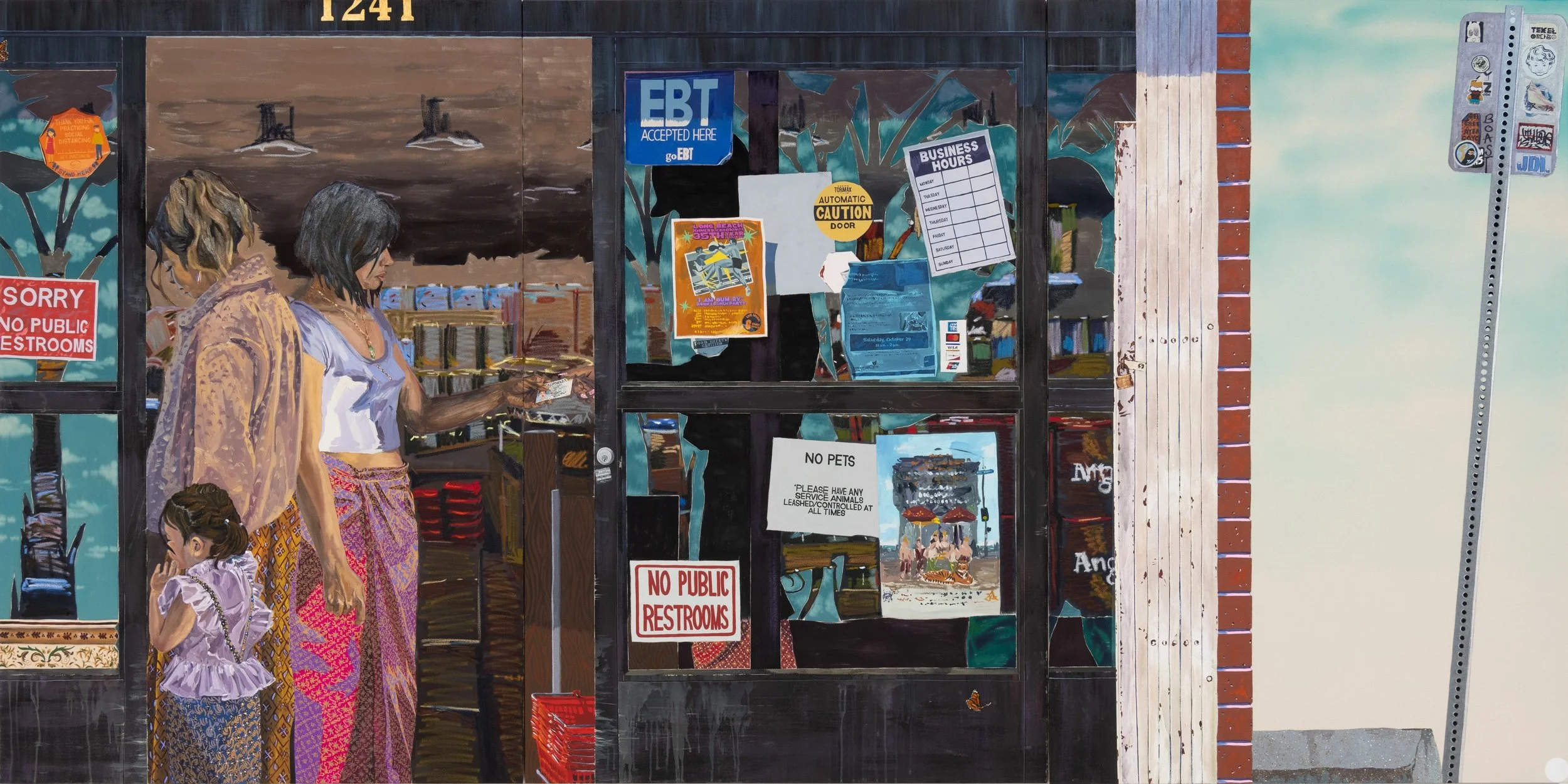
Local Market, 2023
TRINA: Yeah. That's a whole other thing that you're not even really ready for.
TIDAWHITNEY: No one teaches you that shit, right? I can.
TRINA: When I was at this film festival like a month ago with a short film and somebody was like, "Well, you're gonna have to work on your public persona and your blah, blah, blah." And I was just like, ‘What?’ (laugh) And then I realized that I was like, ‘Fuck, I'm not ready for that part.’ I like how you called it the circuit. It’s a lot.
As you're discovering you and your style, what about your mediums? You're painting, but you’re using acrylics and you’re using watercolor. Did that also come of age in 2020?
TIDAWHITNEY: I'm glad that you point that out. Because after Amir, I went to go work for Danielle Dean. She does animation illustration installation projects. She’s done work at the Tate. She's represented by 47 Canal, also represented by Commonwealth and Council. She had me do watercolor backdrops, and that's how it began. I think it was something new for her. I was one of the first assistants to join her on her project, and I began work with her doing small 11 by 17 watercolors. And she was taking from archival, but doing this cool thing photoshopping, and then I would combine it and make it seamless doing a reproduction on watercolor.
That gave me insight on how to process this information and make work that joins in a very kind of, I say, this thread of a dialogue, between different histories that you're speaking from. I took the medium as well because I was like, ‘Oh, I do painting, you know? I work with acrylics right now.’ Amir, he makes works in acrylic, I was able to master it from him. I studied oils in school. And Danielle Dean had me do watercolors. That popped off in 2019, when everything started morphing like that.
TRINA: Yeah.
TIDAWHITNEY: And it made more sense to me because oil paints are expensive and I didn't have any money like that.
TRINA: Let's talk about your subjects. You started looking at the home, the rooms that you're in there and your family.
TIDAWHITNEY: It's 2020.
TRINA: Yeah, you did a whole show that was rooms? Scenes from the home.
TIDAWHITNEY: It was 2021 was when we had all the in-person shows, because 2020 was pandemic. I did a group show, and I did a show at Tin Flats.
At this point, after graduating school, if you can imagine, life happens, right? You need to pay your bills. You need to take care of yourself. And my mom was like, "I'm done with you after you're done with college." She's like, "I'm not taking care of you anymore."
TRINA: Yeah, I had the same, my mom was like, "If you're going anywhere, you take everything in your room."
TIDAWHITNEY: Yeah. My mom was all like, too many kids. It's like some of y'all still living with me. I was like, no, no, no. We can't have that. I understood.
I was living at my aunt's house and at one point I was like, I can't live here no more because it was just as proud and just as crazy. I went to go live at an uncle's house and I'm realizing at this point, I don't really have a base of a home. I'm trying to figure out, you know, how could I get up on my own feet, but I could pay my room at least and the studio. I had a really shitty ass studio, but it was great. The best thing ever.
TRINA: Yeah.
TIDAWHITNEY: I never let go ever since.
TRINA: Yeah.
TIDAWHITNEY: I was visiting my mom a lot. I was saying, "What's up?" Yeah, you're going by. I'll come by, say hi. I think I was picking up food because I couldn't afford to buy my own groceries.
TRINA: That’s what I would do, go back home to try to get fed. (laugh)
TIDAWHITNEY: Are you kidding me? ‘What are you guys doing tonight? Sunday night, you guys having dinner?’ Yeah. At that point, I think I was having great conversations too. My mom was opening about stuff and talking to me in a way she never talked to me before. And it was because I was always the baby daughter and like, I'm still taking care of you because your still going to school and you're 20 something. I graduated when I was 25. I was like, that's pretty old.
TRINA: That's so funny. I didn't even go to college till I was 30 for my undergrad. I was not ready.
TIDAWHITNEY: Oh shit.
TRINA: I tried like twice and dropped out and I was just like this isn't happening. When you're really young, I don't know if every kid should just go right into college. It could be a waste of money and time.
TIDAWHITNEY: I do believe it's all timing; you got to know yourself. I'm like, I do think there should be a break after high school? Yeah, I feel so bad for anybody who lives through that age. It's great, but at the same time, not great. Nobody wants to listen to you guys, like, and yet, you exist with us, and you have a voice. It's like at that age, there's so much oppression and suppression. I feel bad.
TRINA: Yeah. It's, it's true.
TIDAWHITNEY: It’s important, you know? It changes obviously when we leave home and we finally come home. All of a sudden, our parents have a different relationship with us.
TRINA: It's night and day, they see us so differently.
TIDAWHITNEY: I'm number six too, so they must have gotten tired just even. (laugh) It's just hard. Do you have a big family at all?
TRINA: I do, but in my immediate family it's just my mom and I have a younger sister. My father died when I was young and there was drama around that. But cousins, yeah.
TIDAWHITNEY: My mom and I weren't close because she was always unhappy. I didn't understand the unhappiness, and we have a language barrier, and my dad can speak English so I'm always closer to him. When I grew up, I later learned he was the reason for all her unhappiness. Like I remember in middle school when it was like probably the worst and the house, we live with so many people too, you know? That's when my dad was just not on his best behavior.
TRINA: And yet we still don't want it to go by as you get older, you're like, wait, now slow everything down, you know? (laugh) My parents, they both came from very poor families that immigrated and there's a lot of different assimilation, there's a lot of interesting, intricate different ways the assimilation kind of played out too, and I'm still seeing that and I'm still processing that now and understanding it.
TIDAWHITNEY: The immigrant story is…I know…
TRINA: It is. Well, you know, and I feel like it's so different sometimes than what everybody talks about. I mean, we've gotten past the American dream bullshit part, and we've gotten into a different space and it's going to take more generations of really revealing what it was really like to be able to totally change that narrative even a little bit. But that's why I reacted when I saw your work as I walked into Made in LA. My dad went to Vietnam, and my mom told me he was never the same after coming back from that experience. He could never balance any of it and didn't talk about it at all.
TIDAWHITNEY: There was no such thing as therapy back then.
TRINA: Nothing.
TIDAWHITNEY: I just want to write some sort of letter to America. America, why you do me like this? (laugh) Thank you. (laugh)
TRINA: The title of your next show. Yeah, and it's fucking true. they're, they're doing it right now to a whole bunch of people in the Middle East.
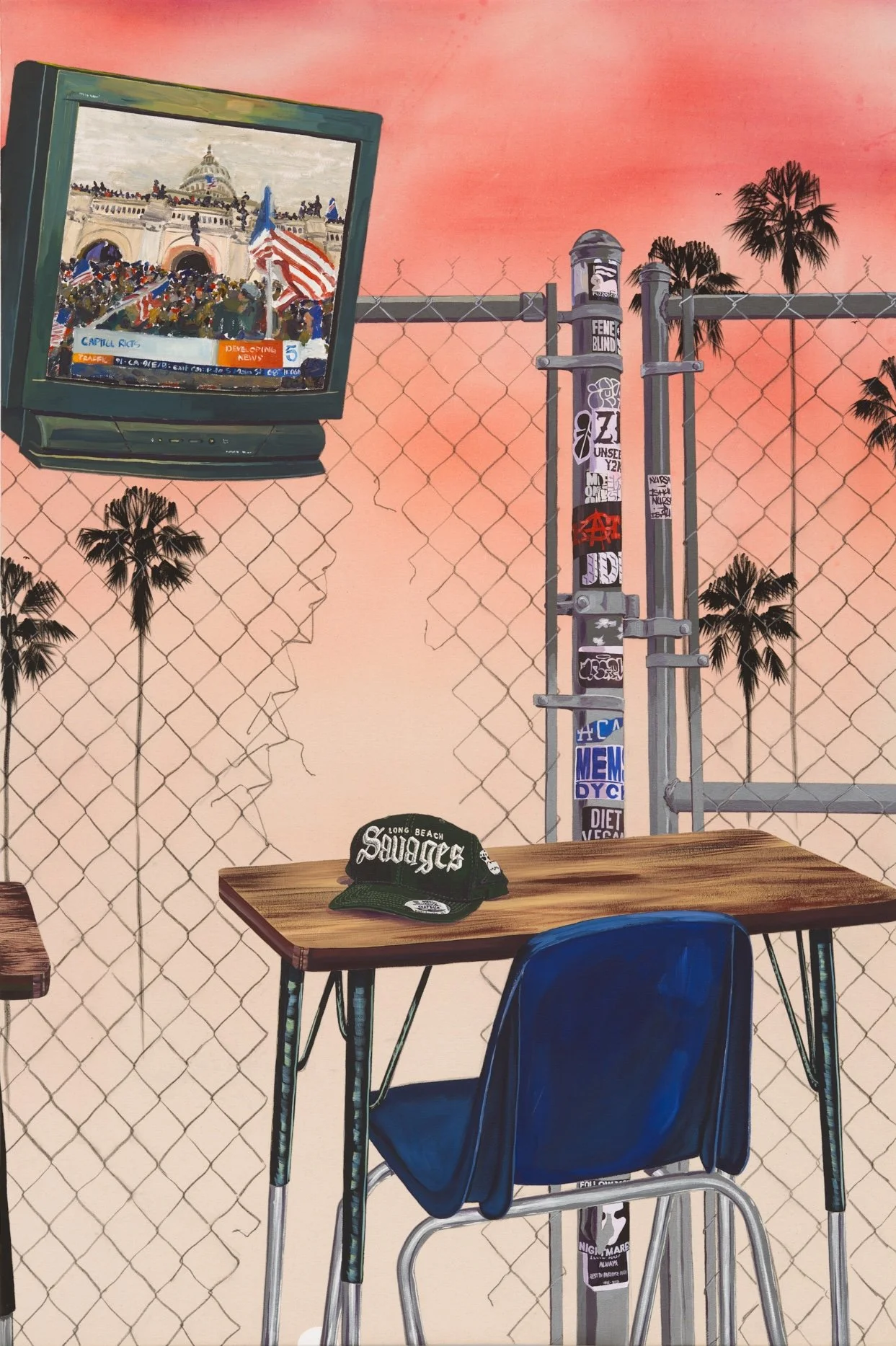
January 6th, 2024
TIDAWHITNEY: Yeah. It's fucking just gross. It's gross. There's going to be repercussions and everybody's worried. It's not just economic. It's not just like how much I'm paying for gas; it's way more than that.
Controlling the story, that's what they're doing. And it fucks me up so hard how it's like been done on our families. I remember watching this documentary and it was Richard Nixon shaking hands with the Donut King.
TRINA: I saw the Donut King documentary!
TIDAWHITNEY: I was like, ‘Ugh, why?’ I was just like ‘how are they Republicans? How are they?’ And then talk about assimilation, talk about Orange County, all of that. It's so fucking crazy that what happens, especially when there was probably intention. There are some people trying to help people, but what the fuck, dude, it's so weird. You can't even, it's bizarre. It's really absurdist. Like you can't even make your shit up. Right, you can't make it up.
TRINA: Dude.
TIDAWHITNEY: That's what we live in, right? That's what we do. That's why I'm trying to figure out how to swallow that shit sometimes. I've been like, ‘Now, now I got to break this down so you guys could like eat it.’
TRINA: That's what you're doing. And you started to break it down. This was something funny because I don't think I had noticed it before, but I was noticing it now, the hands. We can call it surrealist, but I also think there's something very cerebral happening, some subconscious shit that you, that somehow, you were like, how can I track this? Or how can I explain, how can I bring this up?
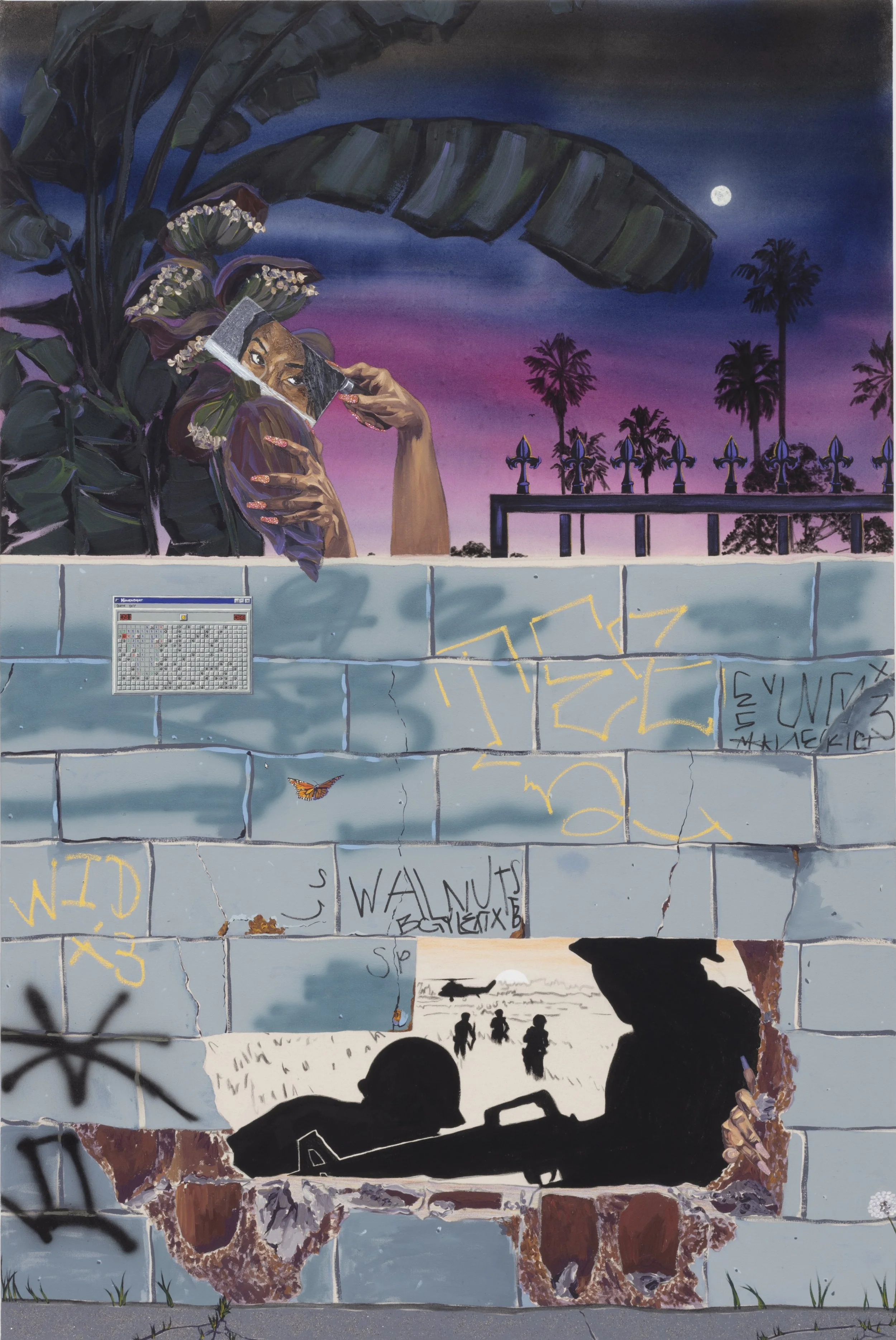
Remembering the War, 2022
TIDAWHITNEY: Funny because there is a story. It was with my mom. I was sitting next to her, we just hanging out and then she sees my hand and she touched my hand. She's like, "Ooh, baby, your hand wrinkly." (laugh)
Oh, thanks mom. Thank you, mom. For me, I just came to this point of maturity. I was like, okay, babe, mom, I understand you mean hardworking. (laugh) The light bulb went off, and besides my face, my hands said something to her and me. I've always actually loved touching; it was funny because another person who came to visit and saw the work had the same stories. I love touch, I have a very intimate, almost sincere memory of my grandmother and mother, her hands were so delicate and soft. And I have that too with my own mom because she has hardworking hands. Her hands are like mine. With everything she's done with her life. This is just a great way to talk about people. I just went on the impulse.
TRINA: Yeah.
TIDAWHITNEY: Another friend who convinced me, because I initially didn't have the nails, and when my mom was like, “wrinkly” and I was like, ‘hardworking,’ I was like, ‘oh, how you gon tell it's a woman.” And I was like, I don't know, let's see what happens. I had a painter, friend, Elmar Guevara and he saw the painting. He was all like, "Yo, that's some hard work and hands." But I don't think he could tell it was a woman. He didn't even know. That's hilarious. I was like, you know what? I add the touch of the nails because we do them anyway.
TRINA: It’s a whole other part of that culture. Especially here.
This is like 2019; you're figuring it out. It's so in process, like in progress process. And so, what struck me is that you have this sense of uniting the outside and the inside, these two different worlds of what goes on outside and what's happening for us inside. We have these different memories of being in these spaces inside with everybody and just knowing every crevice of it because we're just like, okay, where can I get some space here or where's my space here.
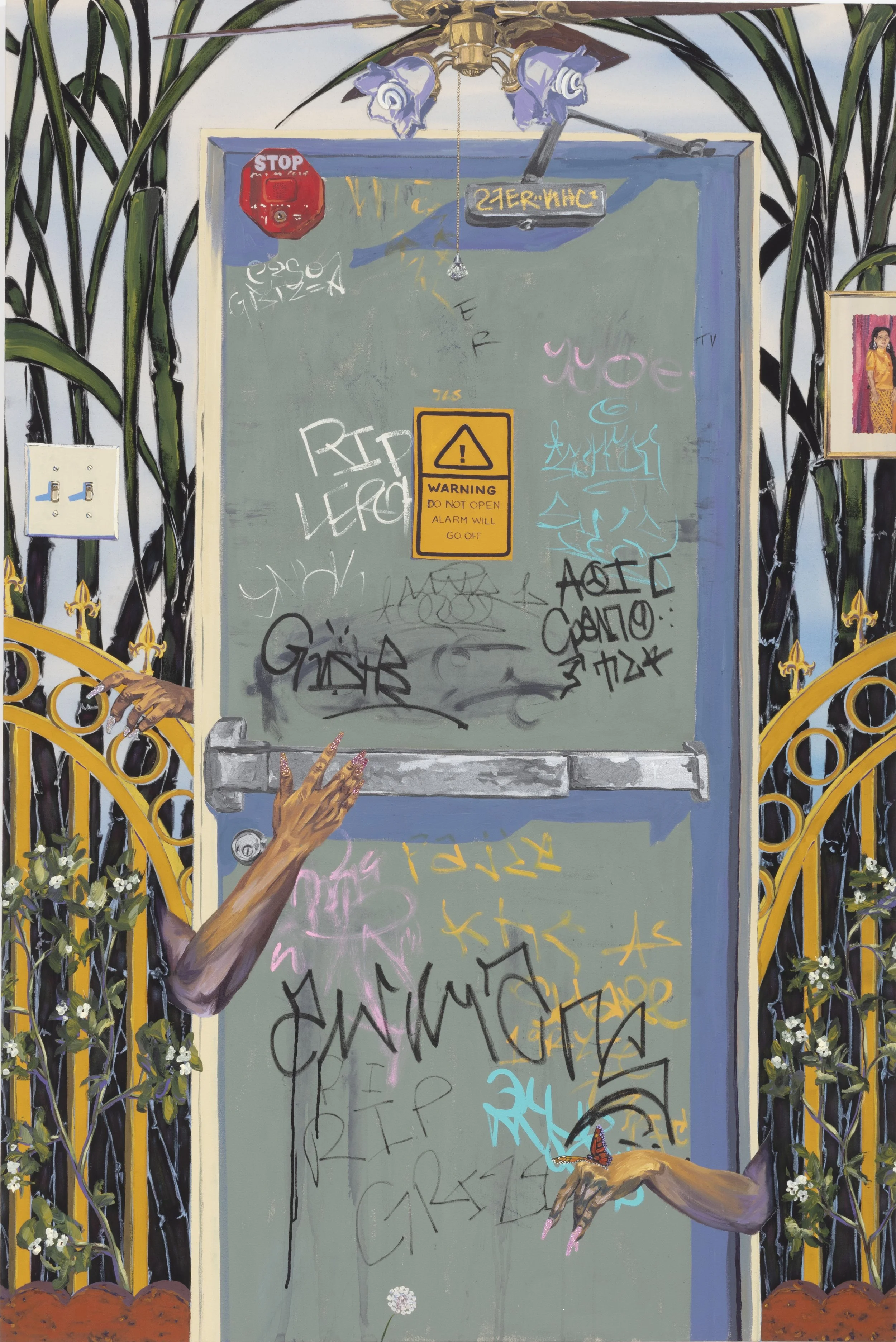
Exit Door, 2022
TIDAWHITNEY: This is even just with fences and gates and like things that come between the two worlds. At this point, I think my brain was like, repetition is okay. Repetition is affirmation, repetition is bringing clarity of what you're trying to talk about.
TRINA: Repetition, I feel like that's natural as artists are figuring out their own language. I think that's common. I think repetition is natural. I think that's why maybe directors use the same actors.
TIDAWHITNEY: That makes sense. A connection. Because you're sure. In a sense, you give them the dice.
TRINA: Yeah. You have to. But you know they know how to roll it.
TIDAWHITNEY: That's it. Place your bets. Place your bets.
TRINA: And this one's even greater because this, this television. That was a story. Tell me about this?
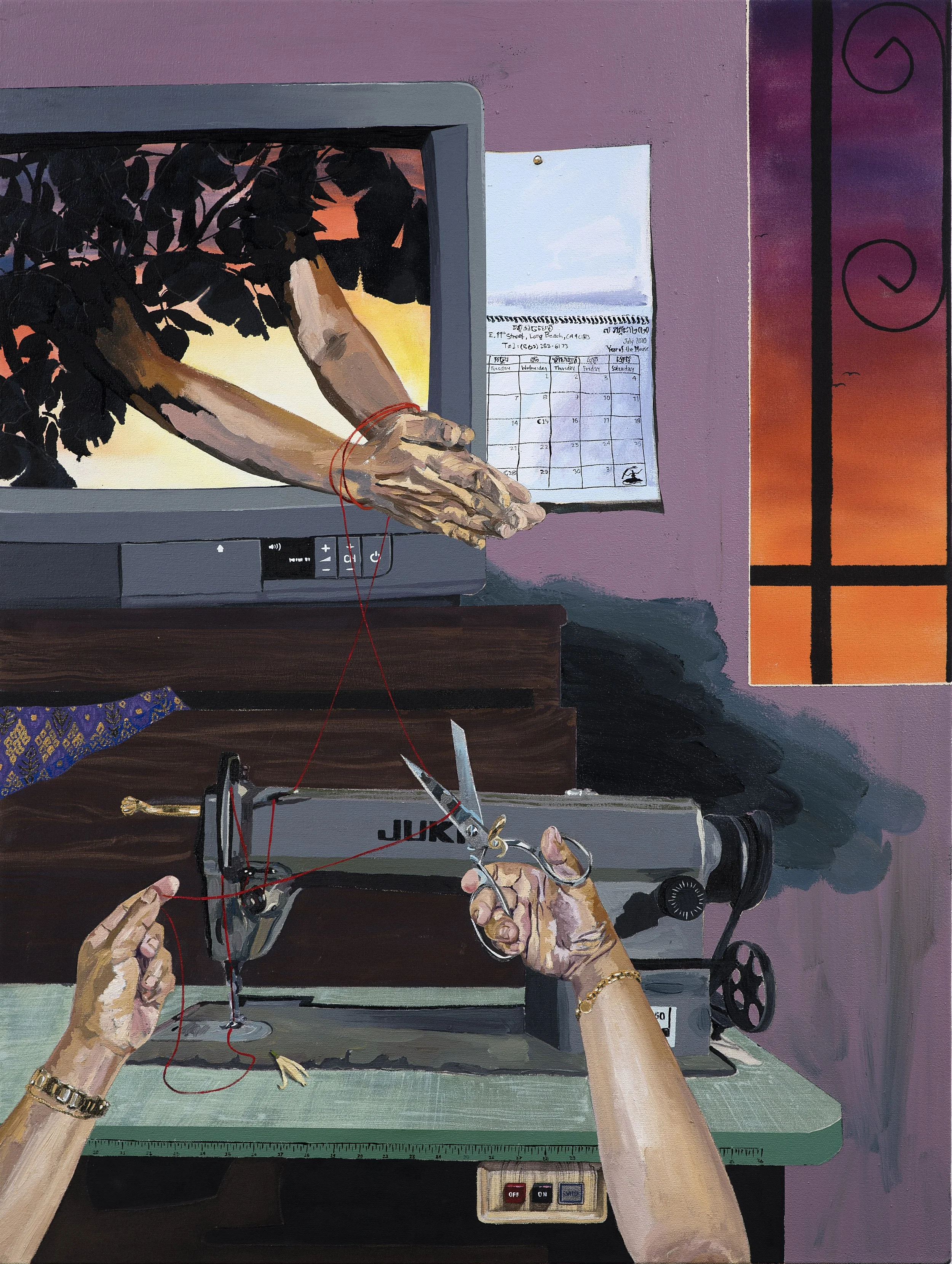
Cutting Threads, 2020
TIDAWHITNEY: Yeah. The one I was mentioning earlier about mom. That one convinced me to make this one.
TRINA: Really?
TIDAWHITNEY: Because we were talking, that conversation went into talking about marriage. I was combining what I see her have lived with being married and she was always sewing and in front of the TV in this room. I feel like her ideas about stuff came from things she saw from that TV box. My mom didn't have too many people to socialize with. There wasn't literally that many friends, especially after she left. We were in a huge apartment complex with a bunch of kids running around, families, all Cambodian, you know, they partied every weekend. But once we moved out, once we had Section eight housing, we lived in a house. She doesn’t know how to drive. She doesn’t speak English. My mom worked, under the table, sewing and tailoring. It was like that. I was also thinking about my oldest sister at the time too, because my mom was always tackling with her to be settled with a man to take care of her.
TRINA: Yeah.
TIDAWHITNEY: But it never went that way. You know?
TRINA: I do because they were just trying to force us into these molds, these models, like that's what you're supposed to do and -
TIDAWHITNEY: The woman does this. The woman does that. And you're gonna find a man and you're gonna have a baby and you're going to do this and that's it. And you're gonna go get your own house.
She had been very conditioned, right? Yeah. And I'm like the youngest daughter, she knows I'm nothing like her. She knows I will refuse to listen. I'm going to go in a different direction.
TRINA: Yeah.
TIDAWHITNEY: Yep. But it was good for her to say her piece of like why she does it that way.
TRINA: What did she think when she saw this painting?
TIDAWHITNEY: She's never seen anything.
TRINA: Has she seen any of your work, or no?
TIDAWHITNEY: No.
TRINA: Really?
TIDAWHITNEY: No. She's come to like at least, for sure one show. She's seen at least three shows. It was the first group show, my first solo show, and my first solo museum show. She came to those three. The museum one was when she like nodded her head. She was like, oh. I smiled because she saw the people were coming up to me and was very impressed with the work and delighted with having to experience with it me. But she doesn’t know what to say. (laugh) Yeah. I know it's so crazy. There's still like this gap, where you're just like, okay, because she's, in real time she's like, ‘oh, this is this world.’ I can't even imagine she had to go home and process that.
Like figure out even what that was about. Because at the end of the day she, she can only be like, uh, "You could, you're doing okay, you can take care of yourself, you know? " that's all she could really, I feel like check in with and which is what I just, that's actually what the most is what I need when I see her, when I see both of them, just to ask me if I'm doing okay, you know?
It's survival, man. It comes back down to, are we okay? We got through that thing. Yeah. Okay, we're okay. I could be like, "I'm okay, mom. Are you okay?"
Money makes her happy.
TRINA: That's my mom, it's money. That’s the love language. It's money and it's food usually.
TIDAWHITNEY: I won't ask, yes, the food. Yeah. I won't ask. She's a bit picky about food, because food is another trauma for her, but I know she's proud. They're both proud. I think it finally hit them.
TRINA: Does your dad have more of the language to talk about what he sees in your paintings?
TIDAWHITNEY: We haven't actually ever really communicated too much on the work. He’s more open to talking about the creative. He probably asks more questions, more than making a comment. But it is different with him t because he's a man. He’s been very conditioned in that way. Yeah, that's -
TRINA: A whole other -
TIDAWHITNEY: It's a whole other can -
TRINA: Of worms.
TIDAWHITNEY: (laugh) But I do understand that they don't understand the level of world, how actually involved I am on an international level and almost, status. I don't know if that's the right word, either.
TRINA: Right.
TIDAWHITNEY: The world is what they're still unaware of, the scale and scope of that.
TRINA: Yeah.
TIDAWHITNEY: I don't think my uncles or aunts can really grip that either, but I do notice a change each time I visit them. I just saw an uncle I hadn’t seen in a long time. I had to drop him off somewhere and it was very interesting to hear him say, "I understand what you're doing now in terms of being an example for my own daughters." That was amazing. I never heard…Beautiful. I never heard you talk to me like that at all. But he didn't even have the words, probably didn't have the language to say it. He didn't even know to say that until he really could grasp it and then try and understand. It's the same thing with my own siblings, if you can imagine.
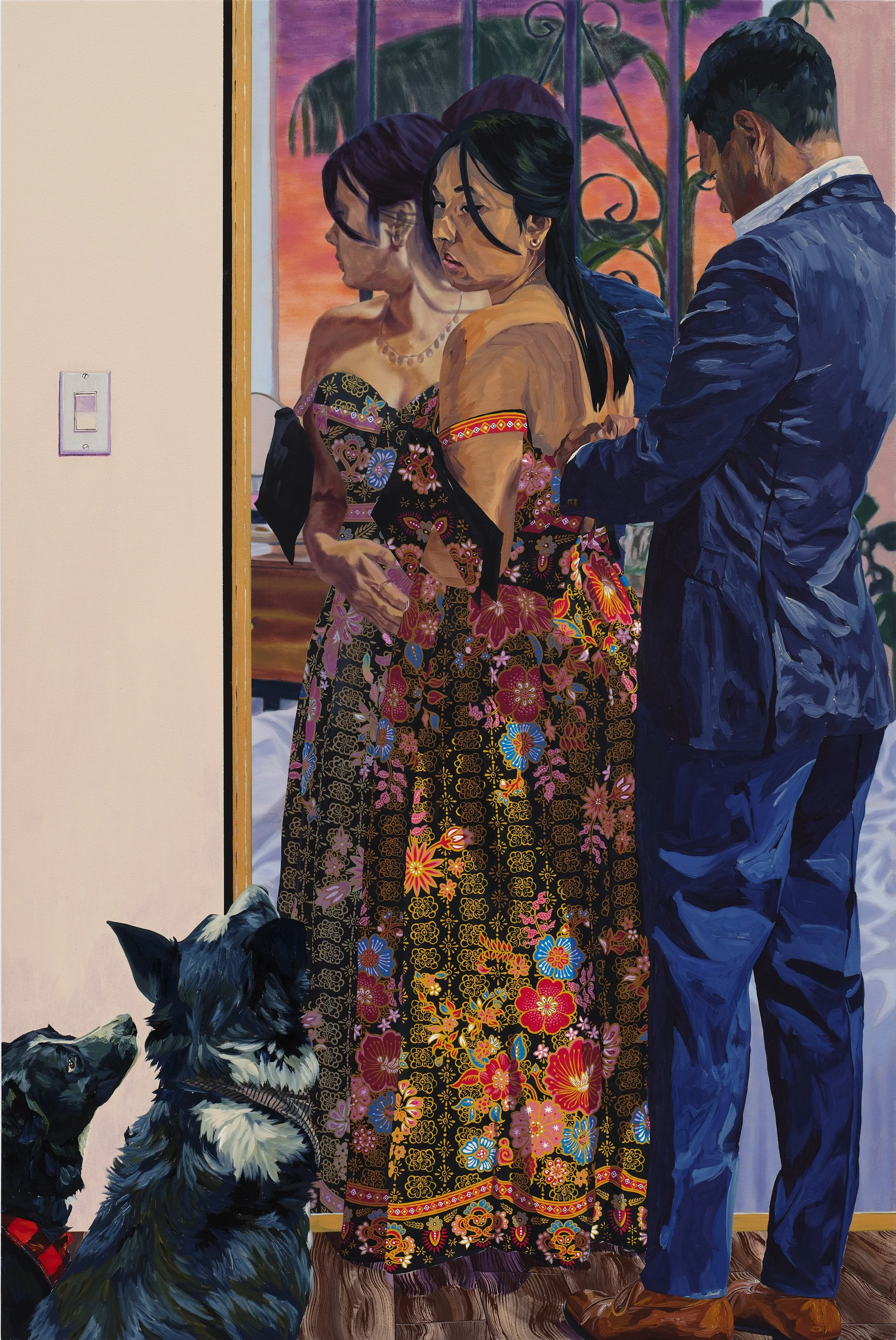
Dressing, 2025
TRINA: Well, because they're older too,
TIDAWHITNEY: They come from a different time. They probably all had their own different struggles themselves trying to assimilate and have their lives. And like you said, get married, have the kid or whatever, have a house. Have the job, have the American dream and all those things.
TRINA: Everybody has their own, different perspective. (laugh)
TIDAWHITNEY: We all journey through this differently.
TRINA: I think once you do get married and you do have kids; people are operating on another level.
TIDAWHITNEY: You got to be honest with the position that we choose to live in. I may not make a lot of money from this, but I got to love doing this.
I'll be spending the rest of my, life like working anyway. I got to work up towards something. And family, that was hard for them to see. It's hard. It's the same way on both my sides of the family; they work really hard. Which is fair. I'm going to work really hard too,
TRINA: It can be a different job. (laugh) It is different, you know? It's like-
TIDAWHITNEY: Something you never dreamed of before.
TRINA: Right. What can inspire you?
TIDAWHITNEY: There's an array of things. But hold on.
She leaves and comes back with a fresh pot of hot tea for us.
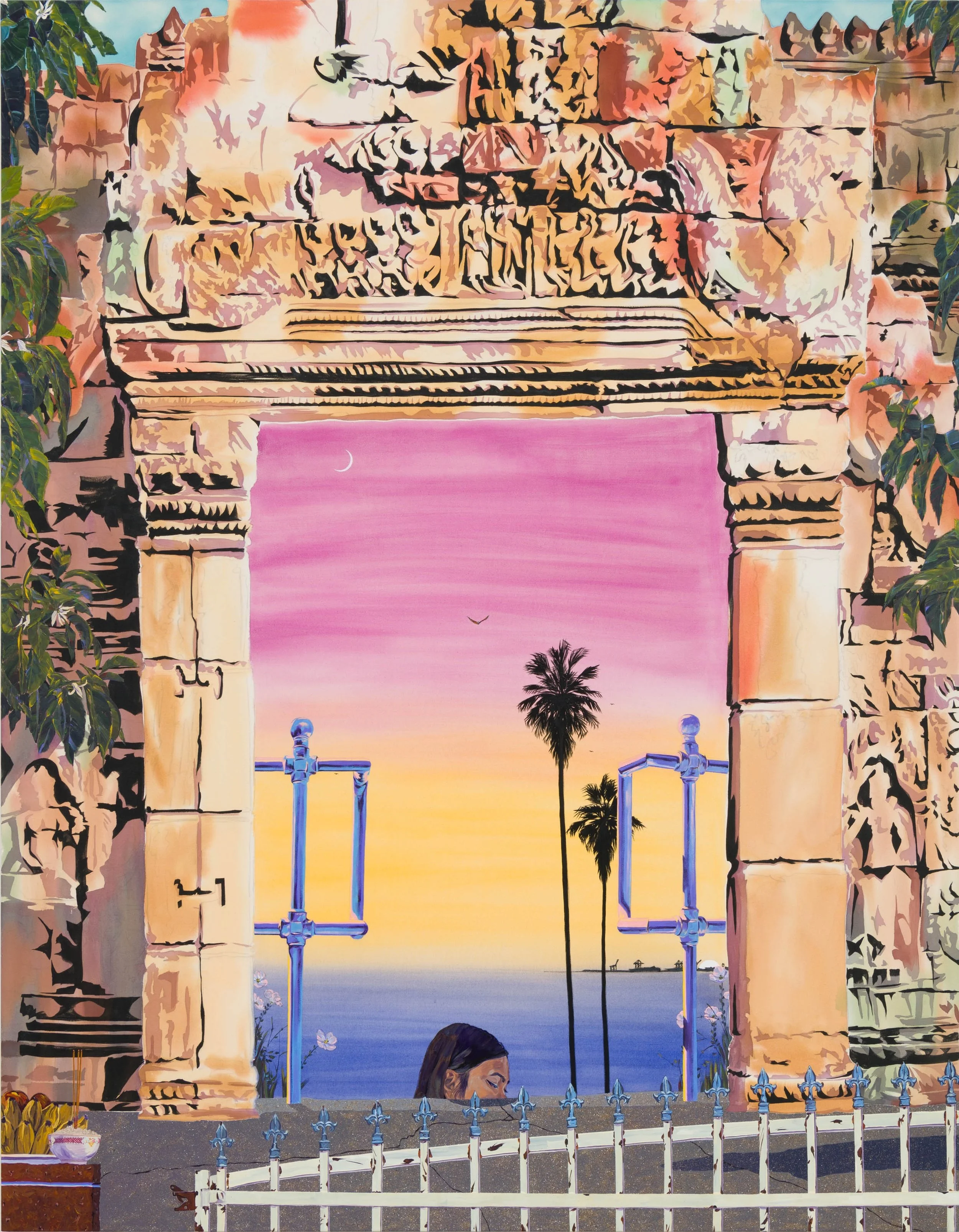
By the Bluffs, 2024
TIDAWHITNEY: It's like a bunch of things. Different mediums. I certainly knew I loved like late 1800s and early 1900 works, so that's the Impressionist era. I’m very familiar with Van Gogh and Augustus Renoir.
TRINA: What was interesting about the Impressionists to you?
TIDAWHITNEY: I guess that was a great way to segue from abstraction. It was like structural, but still basing the language around the medium. Still talking about painting, because painting had, has…I understood painting is a different level of conversation from drawing. It has like a very, like, small, very flat sculptural element, but we still talk about it. We still embrace it in the way we're working with the medium in this form of painting. I could see that very clearly in the pre- impressionist era. What else do I really love? Oh, I loved abstraction. There were these abstract painters that I was learning at the time, like Annie Lapin, there's Julie Marie. I do think of the fathers of some of these. Kandinsky. Mondrian.
They give you reason to understand why art, or at least like this visual language is important. These are how people are responding on a psychological level, on a mental level. It’s all a theory and conversation that we're having. Whether or not you’re verbalizing. Once I started working with artists, there was a bunch of them I was exposed to. There's a particular gallery; it was called Shulamit Nazarian at the time. Now it's called Nazarian / Curcio. I used to work with them. When I assisted, I also substituted when they needed a helping hand. That invited me to meet artists like Cammie Staros and to collaborating with artists not on their rosters, but that did shows with them. That program exposed me to an array of other possibilities I saw. Wendell Gladstone is on their roster. Daniel Dodin was another artist. I remember there was Trenton Doyle Hancock. So cool. That was interesting. It all started opening the door of art itself that has always been out there. That's when I got exposed to the Los Angeles art world scene and their landscape.
TRINA: There are all these galleries here, I think LA's the art capital of the world. There are many different stories being told. There's even more specificity within each of our cultures, big time. And so-
TIDAWHITNEY: It's only right.
TRINA: I think your, your work is happening during a beautiful time here where everybody is noticing everybody. We are being seen.
TIDAWHITNEY: That's our job.
TRINA: You’re bringing it in and, and in all these different ways. What’s going on with all the work in progress?
TIDAWHITNEY:There are some things happening this year. I had a show in May and I have a solo show in November at Night Gallery. And that's what everything is a possibility for.
TRINA: In this, you're actually bringing in Buddha. You're looking at, and there's the hand, right? The hand on the bottom and on the side.
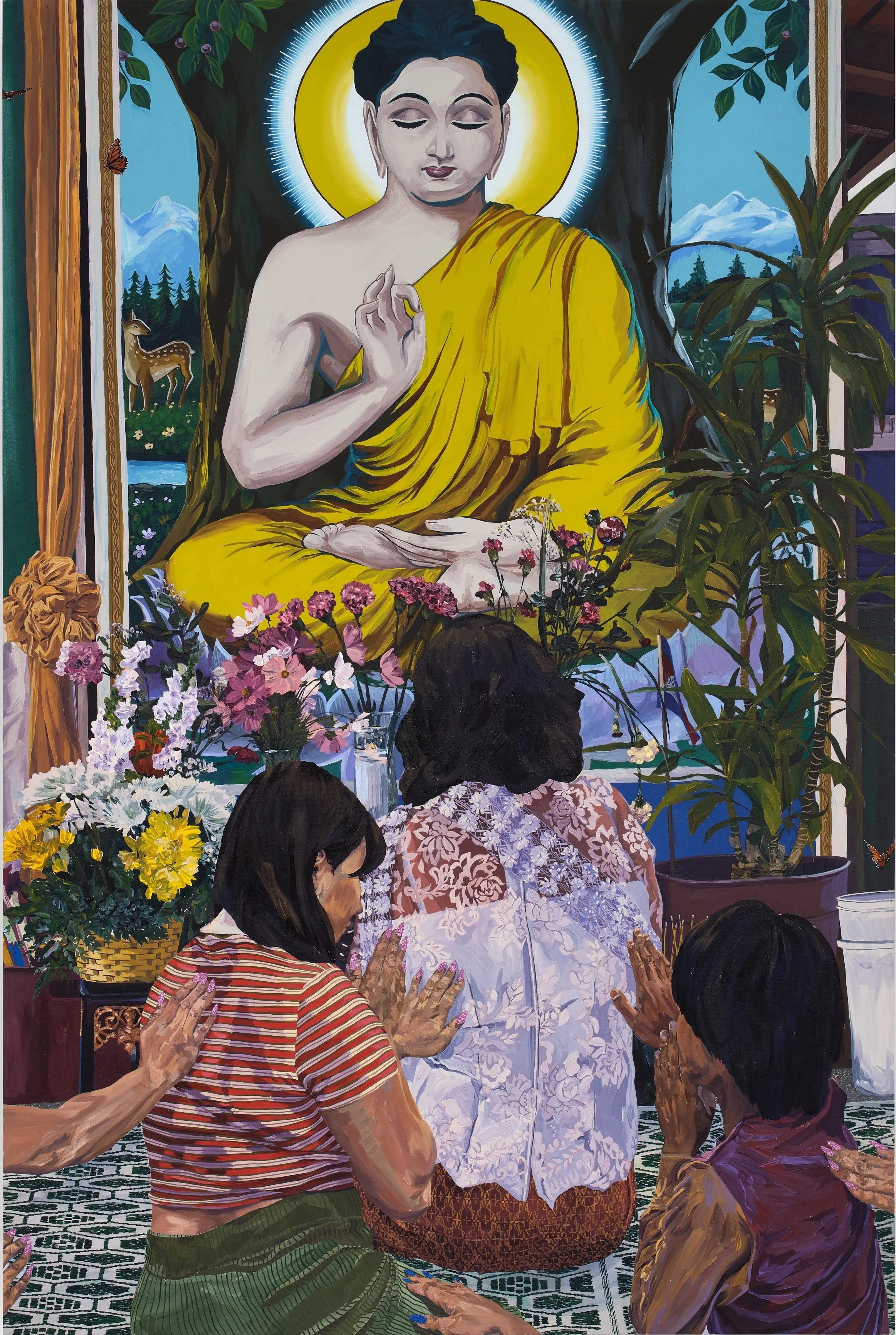
Wat, 2026
TIDAWHITNEY: Uh-huh. Uh-huh. It's so funny because I literally just did this on Sunday. We went to the temple.
TRINA: Nice.
TIDAWHITNEY: With the work, it's evolved into many iterations of the intimacy of domesticity, home and memory. But I use the word mundane a lot and I think it's something I stick with because I just want to invite you to what my daily life is like. I know for a fact that it's not going to be like yours just because of that nuanced difference that I have being what I am, which is Southeast Asian. I carry on these practices for my mother or have this taste from my family. It's just tradition. This is basically an event of us going to one of the temples and the usual occasion is Cambodian New Year.
The temple visit just happened. Everybody was like preparing, everybody gets dressed up. This is a moment during the prayer where everybody has to touch and everybody that touches lead all the way up to the figure that's in the front that's touching the object at the altar.
I decided that would be a nice thing to capture because I know people are familiar with that in terms of other religions too, people up at church. I know at one point everybody knows the classic hands together. That is a practice that we do as humans, there's something about that. I decided to pull that into a painting.
Everything else, like the smaller works, those paintings are more snippets of still lives or moments, but talking about the figure. It removes that part of that composition whereas these bigger portrait pieces, they entail more of a narrative going on and that has its own process and progress, each one of them. Some of them maybe had preliminary drawings and the idea sussed out and others where they're immediately going off the reference, the idea that's been kind of already asking to be made. Everything's in progress.
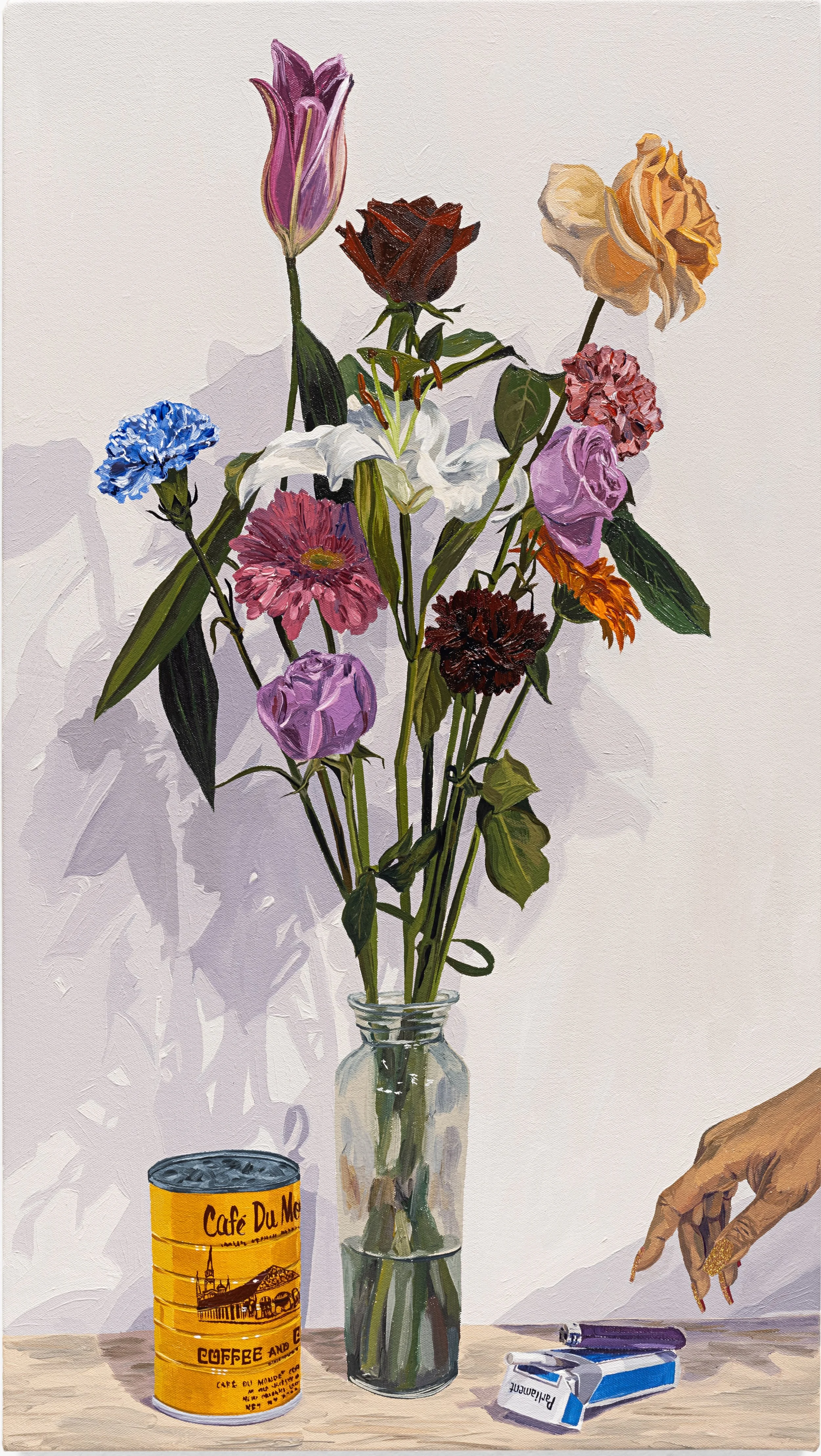
Bouquet and Cigarettes, 2025
TRINA: What's your daily routine like?
TIDAWHITNEY: After I graduated, I had this routine that worked so good and I tried to replicate it again, but life gets that you guys can't do shit again. It would be like three straight days of progress where I'm just going at it at the canvas and I would sleep at the studio. Then two days of not coming in. And then I would go back in again, three days of straight just being in here, hashing it out, sleeping in the studio, and then two days of not coming back. I'm full-time now so I have the privilege to take my time. The usual routine is, I commute, I live in Long Beach. Yeah. It's like a 45-minute drive window.
TRINA: What do you do in those 45 minutes?
TIDAWHITNEY: I listen to the news on the radio from time to time, NPR or sometimes music or sometimes silence. But it takes a minute to start anything. I'm usually pacing. I'm cleaning up my mess because no one cleans up after me. Usually pacing a lot. I'm reflecting during my pacing period, like me cleaning up, thinking about this thing about that. Like a lot of stuff that just happened recently for me, like I just bought a house with my partner.
TRINA: You did?
TIDAWHITNEY: Yeah. I was like, oh, shit some adult stuff. Yeah, that's straight up. We’re going to be broke for the rest of my life.
TRINA: (laugh)
TIDAWHITNEY: I mentally prepared myself like that. I'm going to be fine. We're going to be fine. We're going to be fine. Right. And we're getting married this year too.
TRINA: That's exciting.
TIDAWHITNEY: So, we're going to put the wedding plan together, I was like, ‘man, I don't want to fight at you about this.’ I was like, all expensive, okay, lives expensive. And I smoke a lot of marijuana. Weed.
TRINA: Medicine, girl.
TIDAWHITNEY: It just kind of, it helps me just be frank. I don't know what it does, but I feel like it's always a time thing.
TRINA: Yeah. (laugh) But it does, it just takes everything down a notch and you're opening more pathways in your brain and you're allowing your brain more chance to react to each other.
TIDAWHITNEY: I feel you. Just letting life speak for itself. You want this control and you also feel like you need to have it. But in the truth of it all, you never had it.
TRINA: We never do have it.
TIDAWHITNEY: You never had it. I wake up and have to remind myself that every day. I come back in here and it's time to work.